
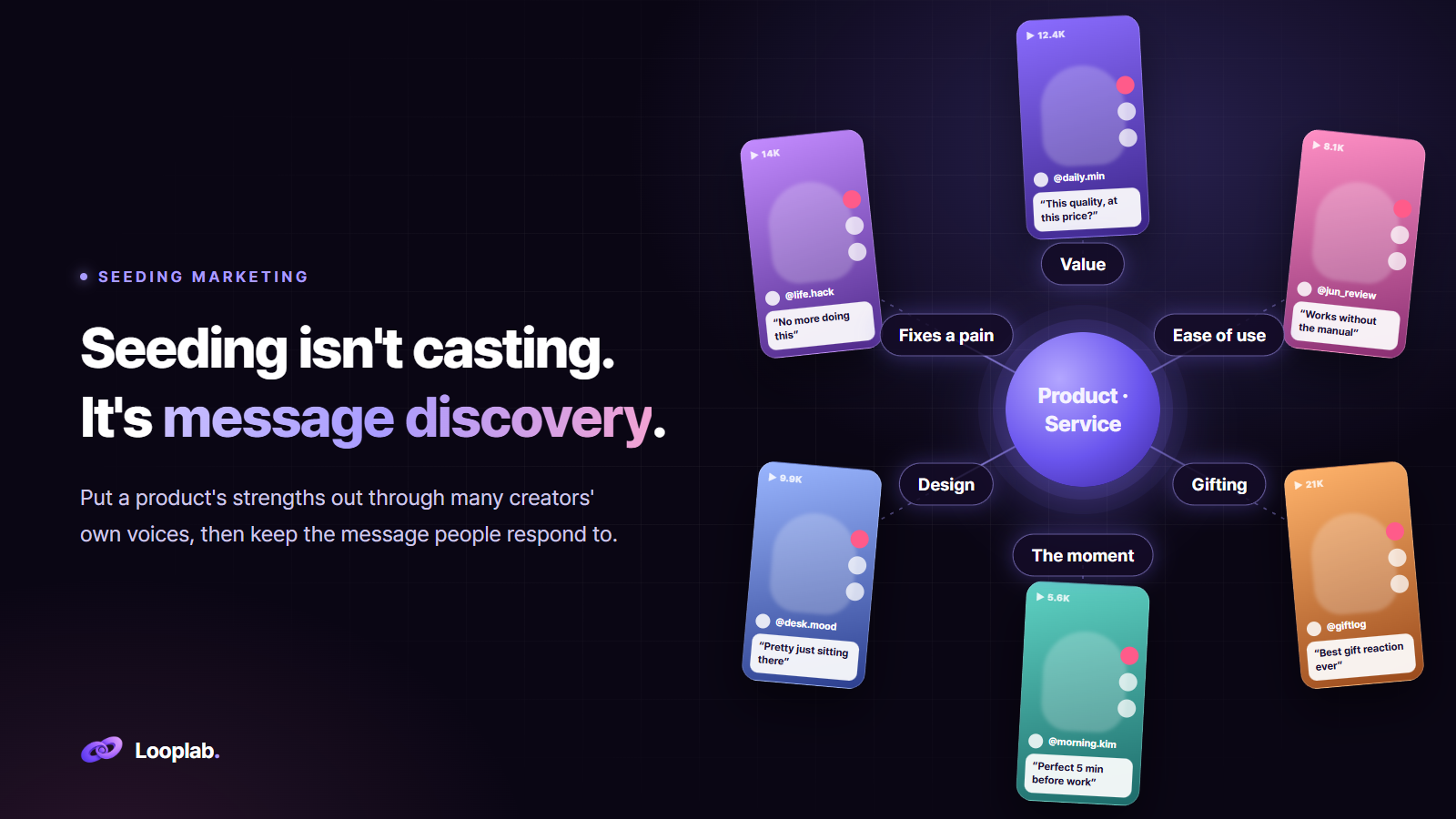
When brands start seeding marketing, they often think about creators first.
“Should we work with creators with a lot of followers?”
“Who gets strong views?”
“How many people should we send the product to?”
These questions matter. But they are not the most important ones.
The better question is:
What part of this product or service will people want to talk about?
Seeding marketing is not just sending a product and waiting for videos to appear. It is a process of testing different angles through different creators, then finding the message that actually gets a response.
1. Seeding Is Not Production. It Is Discovery.
If you treat seeding like content production, the campaign can quickly lose its strength.
The brand starts asking creators to follow specific scenes, lines, and formats. The creator starts speaking less naturally. The final video may look polished, but on TikTok or short-form platforms, it often feels like an ad and gets skipped.
Good seeding works differently.
The brand first prepares several possible message angles.
Creators then express those angles in their own voice and situation.
After that, the brand looks at which message actually gets a response.
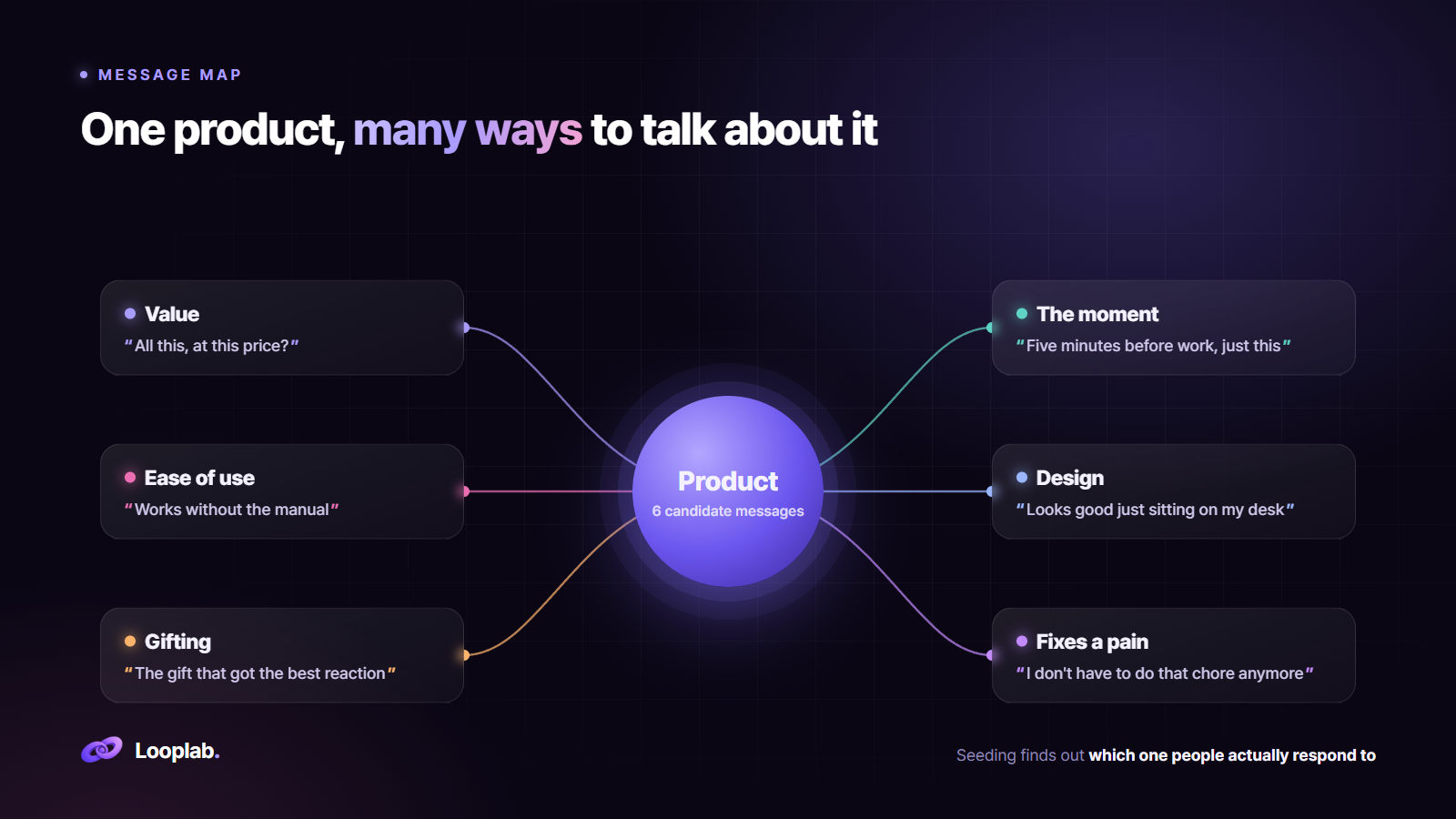
For example, the same product can be talked about in many ways:
- It is good value for the price
- It is easy to use
- It makes a good gift
- It is useful in a specific situation
- It solves a common problem
- It looks good or feels good to own
The goal of seeding is to find which of these angles works in the market.
2. What Comes Before Creator Selection
Before choosing creators, a brand should decide what it wants to test.
This does not mean giving creators a script and asking them to read it. It means deciding which part of the product or service each creator should experience and talk about.
For example, for a beauty product, “good ingredients” may not be the strongest angle.
“Easy to use in the morning without clumping” may feel more real.
For an app, “many features” may not be the strongest angle.
“Finishes a daily task in 10 seconds” may be much clearer.
The brand’s job is not to control every word.
The brand’s job is to separate the message angles clearly enough to test them.
A seeding campaign can be designed around angles like:
- Function
- Use case
- Emotion
- Comparison
- Price or benefit
- Design
Then each creator can be matched with a different angle, and the brand can see what people respond to.
3. Seeding and Performance Marketing Play Different Roles
Seeding marketing is not the same as performance marketing.
Performance marketing is good at taking a clear message and pushing it to more people. It helps drive actions such as clicks, visits, sign-ups, or purchases.
But if you spend ad budget before knowing which message works, the campaign can become inefficient very quickly.
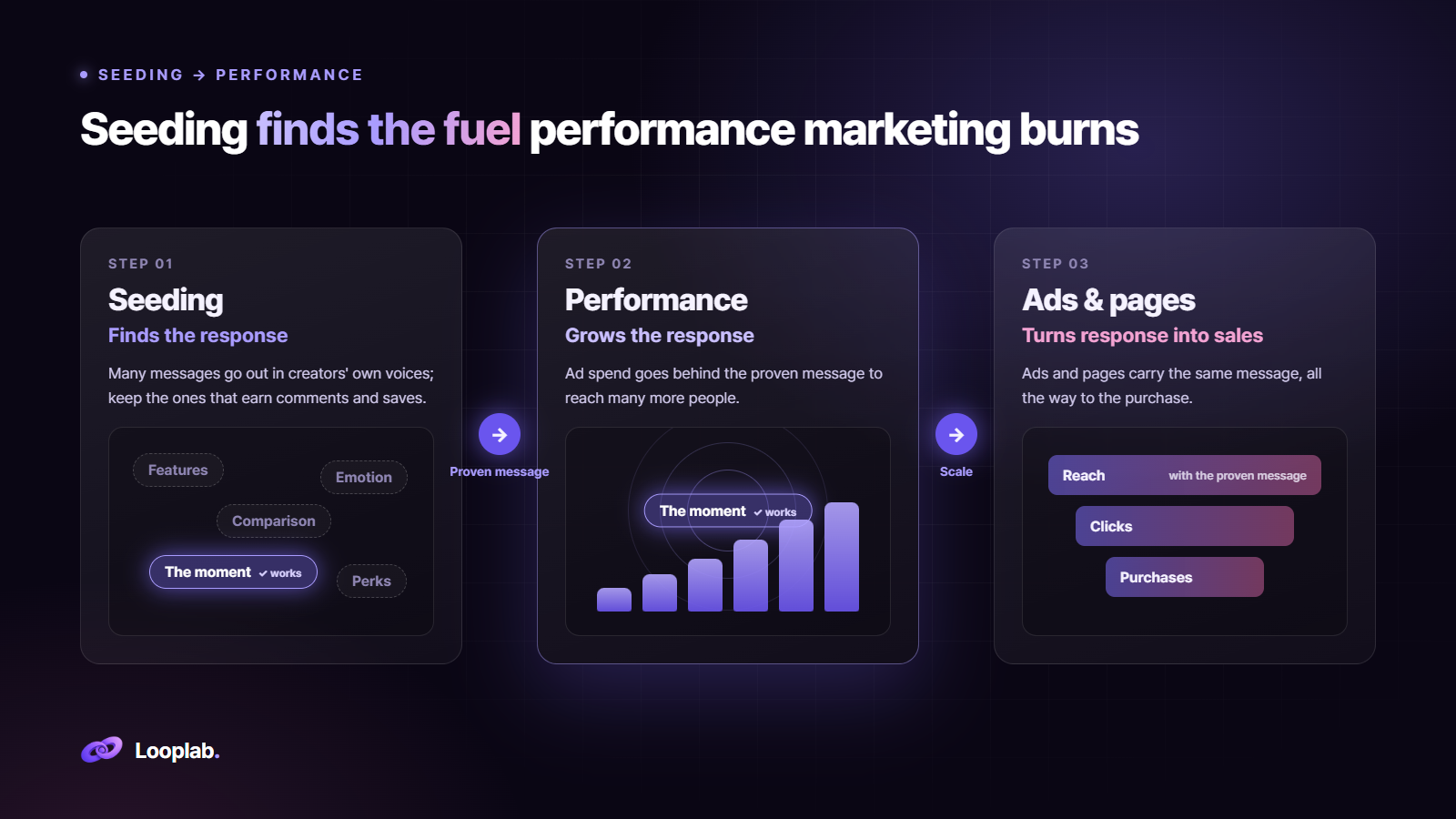
Seeding works before that stage.
It helps you find:
- What people comment on
- What situations make people save the content
- What words make the product feel useful
- Which creator style fits the brand
- Which video could be expanded into an ad
The message found through seeding can later be used in ads, landing pages, product pages, and creator-led performance content.
So seeding is not a smaller version of performance marketing.
Seeding helps find the message that performance marketing can scale.
4. Creator Casting Is a Way to Expand a Proven Message
Sometimes a campaign needs a specific creator.
For example, the brand may need a creator to visit a location, follow a planned structure, film certain scenes, or create content that can be reused in ads.
That is creator casting.
But creator casting has a different role from seeding.
Seeding opens up different possibilities and finds what works.
Creator casting takes a message that already works and turns it into more controlled, higher-quality content.
A healthy campaign often follows this order:
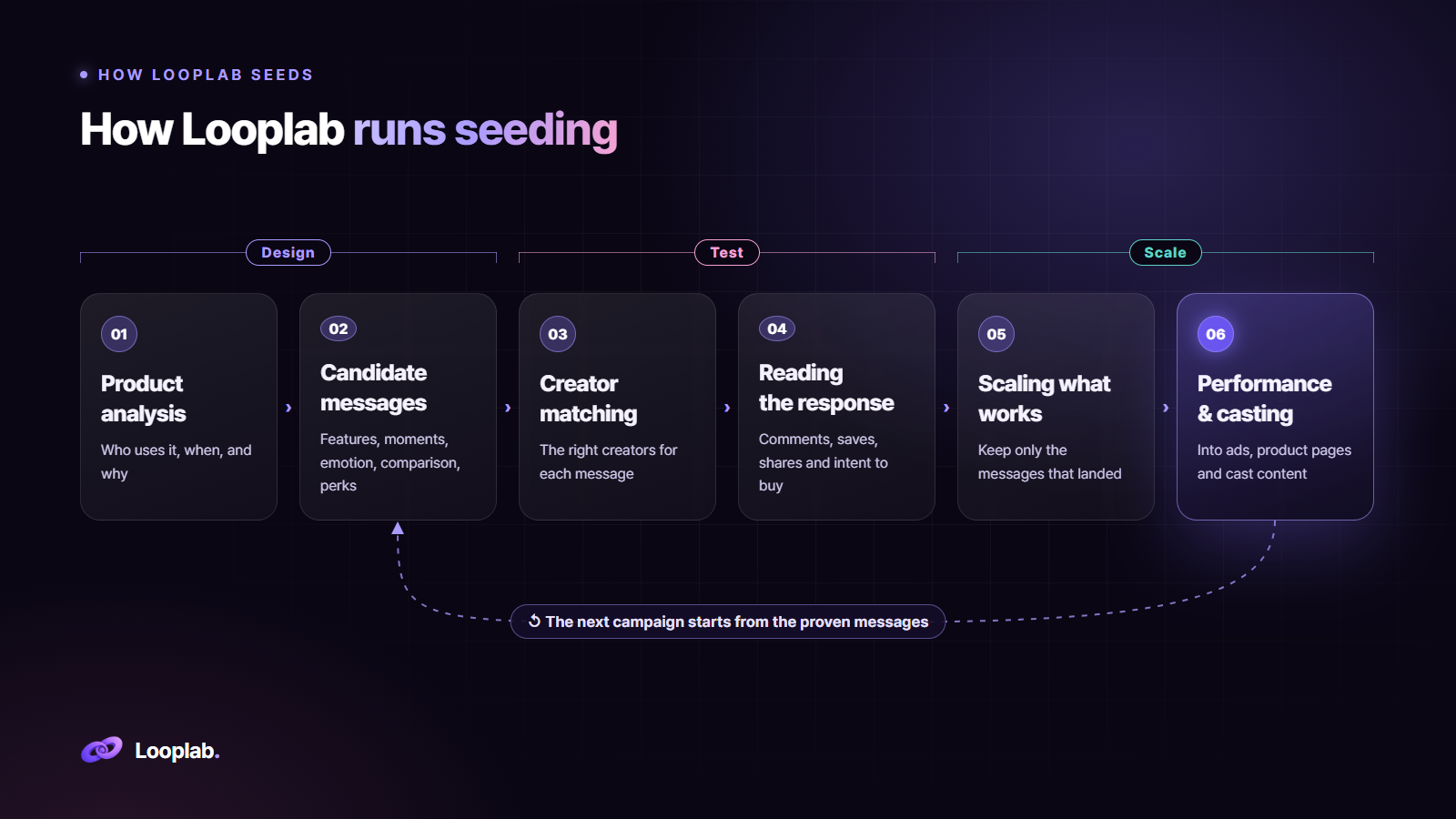
1. Test several messages through seeding.
2. Find the message that gets the strongest response.
3. Select creators who fit that message.
4. Expand it through performance marketing or creator casting.
If you ask every seeded creator to deliver highly controlled content from the beginning, you lose the main value of seeding. But if you use seeding first and cast creators based on what worked, the next stage becomes much stronger.
5. The Result of Seeding Is Not Just the Number of Videos
At the end of a seeding campaign, it is not enough to count how many videos were posted.
The more useful questions are:
- Which message got the strongest response?
- Which creator’s tone matched the product best?
- Which use case created comments?
- Which content can be expanded into ads?
- Which message should we stop using next time?
The real output of seeding is better decision-making.
A good seeding campaign should help the brand decide what to say next, who to work with again, and what kind of content should be scaled.
6. Good Seeding Is Not About Sending More. It Is About Learning Better.
Seeding marketing is not about sending products to as many people as possible.
It is not just about finding famous creators.
Good seeding is about finding the response point inside a product or service.
What should we talk about?
Which angle feels natural?
Which creator can express it well?
Which message is worth scaling?
This is how Looplab approaches seeding marketing.
Seeding is not a cheap way to make content.It is a way to find the words that work in the market.