If you have ever pitched a collaboration to creators overseas, this may sound familiar.
“This offer worked well at home. Why is it so quiet abroad?”
“We translated it carefully. What went wrong?”
Looplab reviewed 1,926 outreach messages we sent through TikTok DMs between June 2025 and October 2026, grouped by language. We tracked how far each offer progressed in Korean, Japanese and Traditional Chinese (Taiwan), and where conversations stalled.
The short answer: overseas outreach does not stall at just one stage. It leaks a little at three points: the first message, the fee and the schedule.
1. The numbers make the gap clear
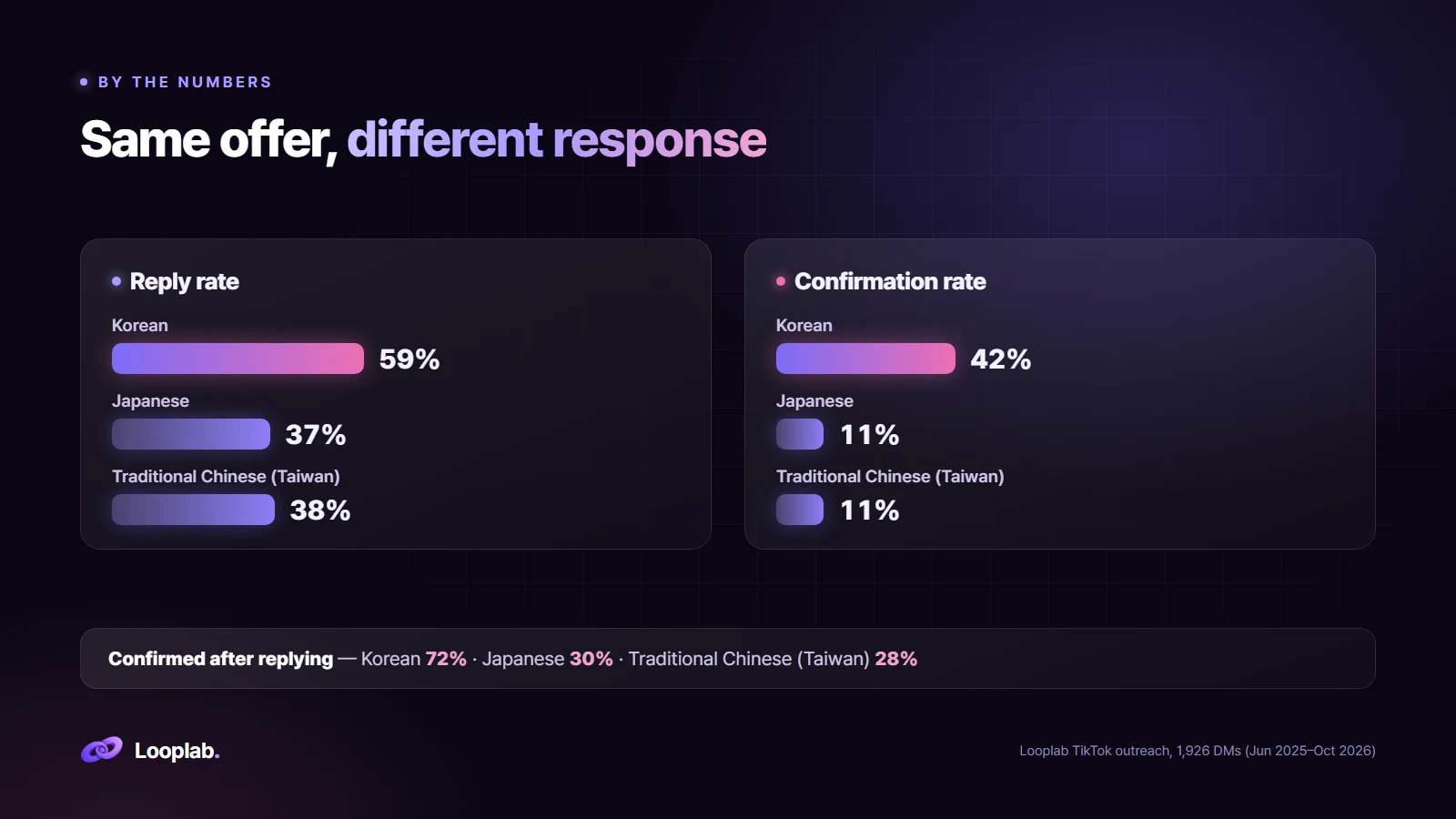
Reply rate: Korean 59%, Japanese 37%, Traditional Chinese (Taiwan) 38%
Confirmation rate: Korean 42%, Japanese 11%, Traditional Chinese (Taiwan) 11%
What happens after the reply deserves a closer look. Among creators who replied in Korean, more than 7 in 10 (72%) went on to join the campaign. For Japanese and Traditional Chinese (Taiwan), it was about 3 in 10 (30% and 28%).
Overseas creators reply less often, and fewer of those who reply go on to confirm. Translation alone does not close that gap.
2. Where does it stop? Three points
First, it stops at the first message.
A first DM usually lands in message requests. If the preview does not make the purpose clear, creators do not open it. With overseas creators, there is another factor: wording that sounds translated. Translating a Korean greeting such as “Have a nice day” word for word, or using someone’s full nickname, complete with symbols and emojis, makes a message look like a mass DM.
Second, it stops at the fee.
An unusually large number of overseas outreach conversations remained “in negotiation.” In Japanese, 35 were in negotiation and 25 were confirmed, so negotiations outnumbered confirmations. Traditional Chinese (Taiwan) was 31 to 24. In Korean, 58 were in negotiation and 605 were confirmed. Overseas creators were often interested, but conversations stalled over the gap between the fee they expected and the fee offered.
Third, it stops at the schedule.
When creators explained why they declined, scheduling was the most common reason. If the upload window is shared too late or is too short, creators cannot take part even when they want to.
3. Same language, different results
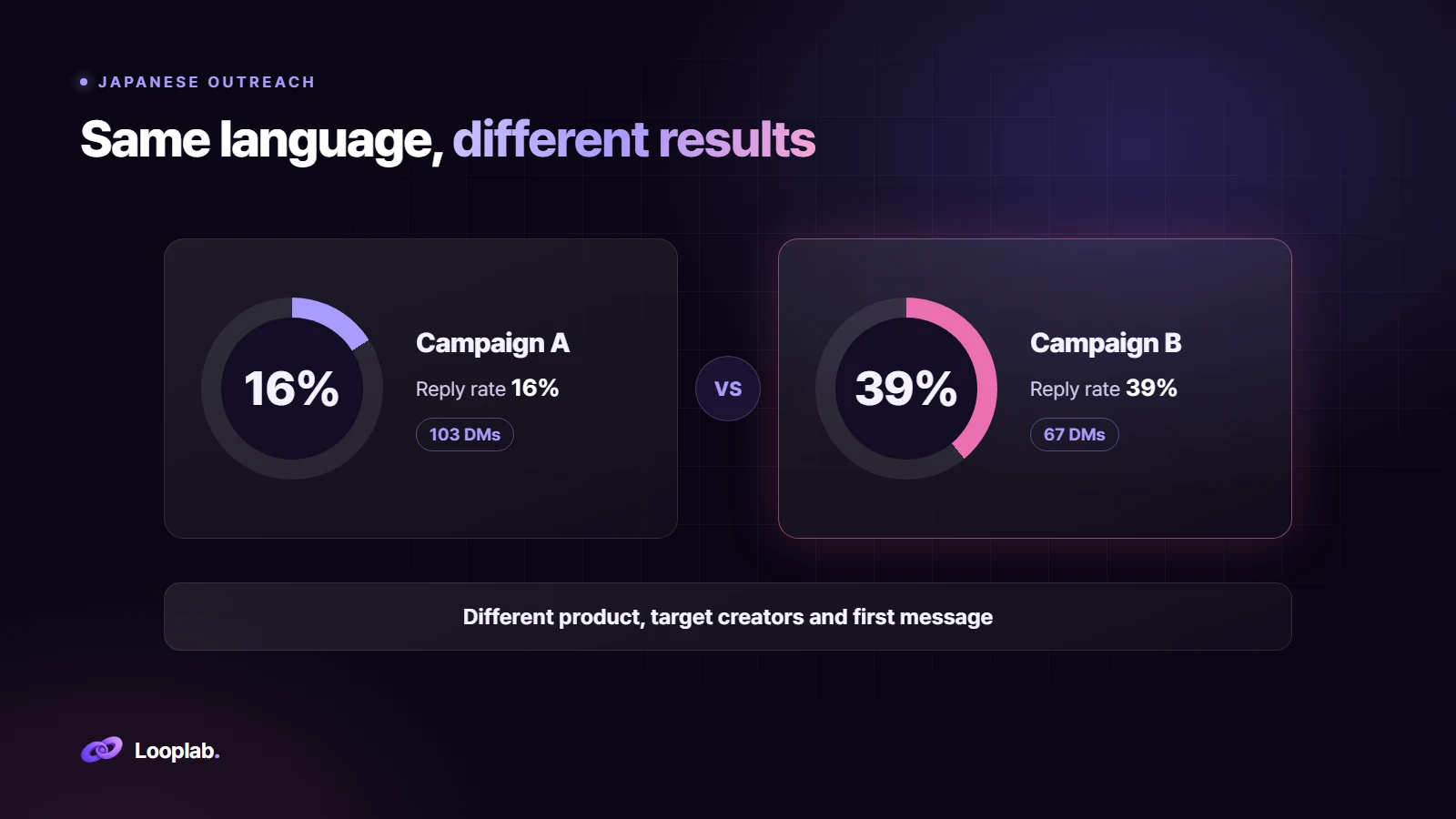
Results also varied within Japanese outreach. One campaign had a reply rate of 16%. Another had 39%.
The campaigns differed in product, target creators and first message. This suggests who you pitch, what you offer and how you say it matters more than using the same language. Localization goes beyond translation. It means shaping an offer to fit the creator.
4. Five ways to localize the first message
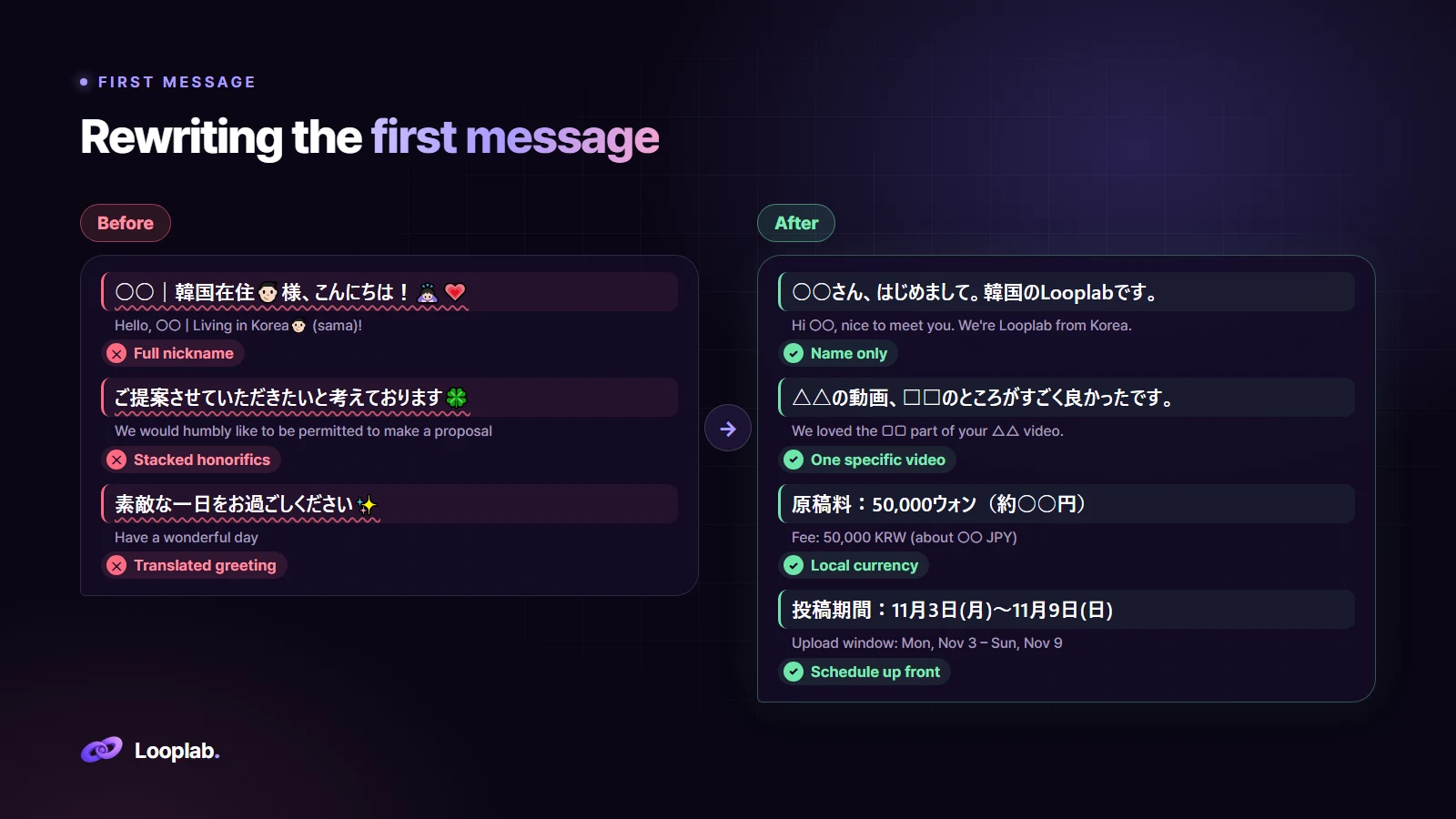
Use the name they go by, once
Remove the symbols, emojis and descriptions attached to a nickname, and use just the name. In Japanese, “○○さん” sounds more natural to a creator than “○○様”. Do not repeat the name at the end of the message.Cut greetings that sound translated
Cut phrases carried over from Korean, wording that sounds like a formal notice and layers of honorifics. Short, plain sentences feel more sincere.Praise one specific video
“I love your video style” could be sent to anyone. Mention one video you actually watched and keep it to one line. If you cannot name anything specific, skip the compliment.Show the fee in local currency, too
If you list the fee only in Korean won, the creator has to convert it. Including an approximate amount in local currency helps keep conversations from stalling over the fee.Make the schedule clear from the start
Include the upload window, with dates and days of the week, in the first message. Creators who are unavailable can let you know early, while those who are available can start preparing right away.
Overseas outreach is a conversation, not a translation
Language is not why most overseas creators stay silent.
A first message that does not feel written for them,
a fee they struggle to put into context,
a schedule they hear about too late.
Looplab writes a separate first message for each language and uses the messages we send and the replies we receive to keep improving our next offer. If you are planning a seeding campaign with overseas creators, let’s work on the first message together.